
A quiet space for coming back.
When returning to something you left feels harder than it should - Harbor is there. Not to fix you. Just to sit with you.
Behavioral Design
AI Agent
Built & Shipped
Most tools assume you're ready to sprint.
Harbor is a conversational AI agent designed for people navigating the fragile moment of returning — to school after a break, to work after time away, to routines that quietly fell apart.
It's not therapy and it's not a productivity tool. It's a quiet presence that acknowledges the weight of re-entry without rushing you through it.
I designed it, built it, and shipped it.
The gap no one was designing for.
Productivity tools
assume momentum.
Habit trackers, streak counters, goal-setting apps - built for people already moving. They punish absence instead of supporting return.
Therapy apps are too heavy.
Not everyone needs clinical intervention. Sometimes you just need something that says "this is hard and that's okay" without pathologizing the feeling.
Nothing sits in the
in-between.
The moment before you're ready — when you know you need to go back but can't quite start — has no product. Harbor lives there.
Design Decisions
Every choice traces back to one question.
What does someone in this moment actually need? Not what sounds impressive. Not what fills a feature list. What would genuinely help?
Decision 01
Why ocean. Why conversational.

Water doesn't judge pace. It doesn't track how long you've been away. Harbor's ocean isn't decoration — it's the interaction model. The night sky, the waves, the moon — they set the tone for a conversation that listens before it suggests. No to-do lists. No action plans unless you ask. The default mode is presence: acknowledging what you're feeling before telling you what to do about it. Tides come and go. So do people.
Decision 02
Why the cozy corner.
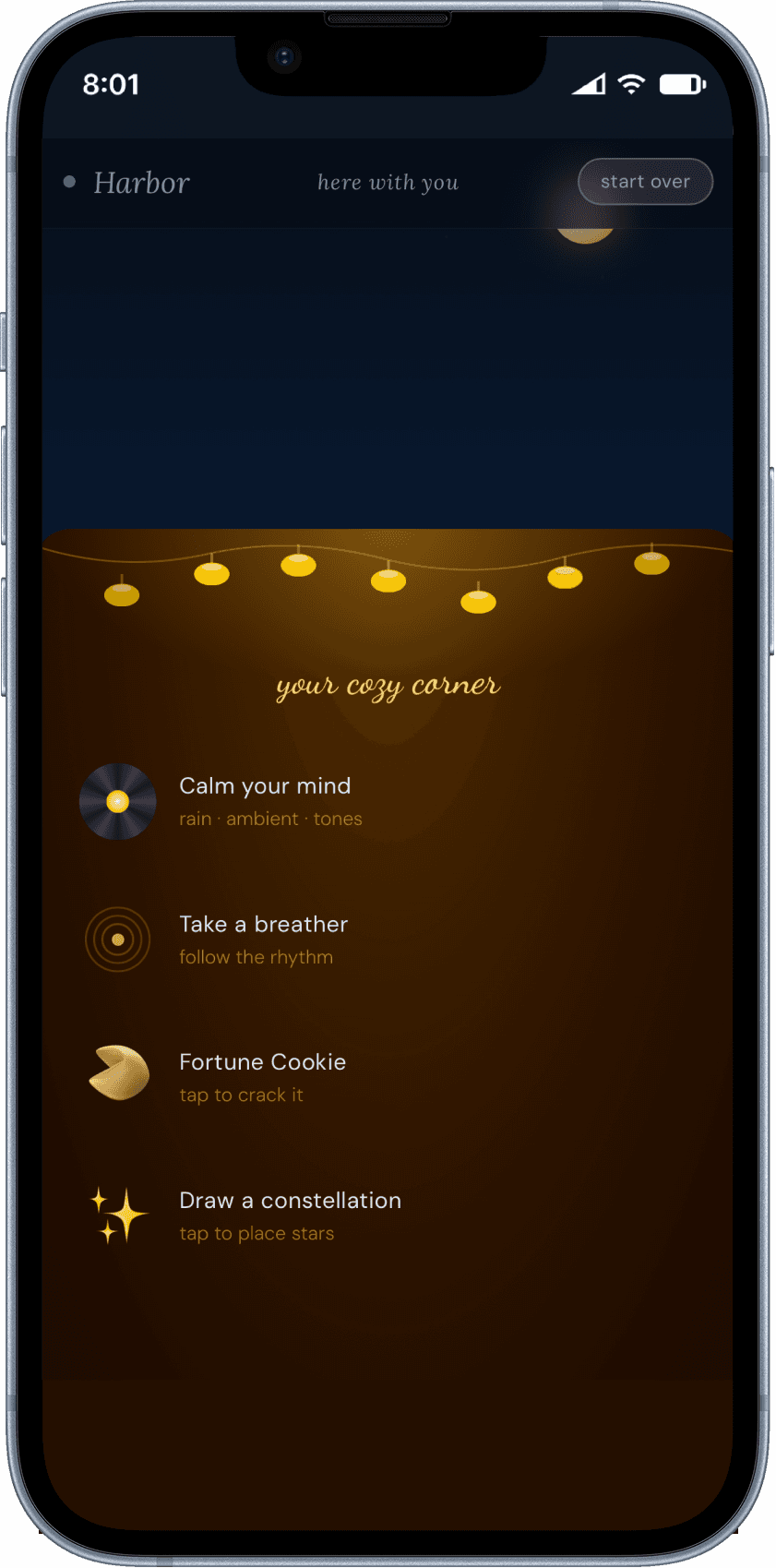
Not everything needs to be a conversation. Sometimes you just need to sit somewhere warm. The cozy corner is a separate space — string lights, no chat, no AI. Just four gentle things to do: calm your mind with rain and ambient sounds, follow a breathing rhythm, crack open a fortune cookie for a small affirmation, or draw a constellation by tapping stars into the night sky. Each one is tiny, self-contained, and completely optional. You don't earn points for using them. They're just there.


THE PRODUCT
Harbor in action.




"The best AI companion doesn't demand your attention. It earns your
trust by knowing when to step back."
Reflection
Designing for the quiet moment.
Harbor taught me something I keep coming back to: the hardest design problems aren't about capability — they're about restraint. The AI could do more. It could track mood, set goals, send daily check-ins, build habit streaks. Every feature I considered, I asked: does this serve the person, or the product?
Most of the time, the answer was the product. So I cut it.
What remained was something small and quiet — a conversational agent that listens before it suggests, a fortune cookie you open when you feel like it, and a presence indicator that says
"I'm here" without saying "where have you been?"
This project also proved something to myself: I can ship. Not just design in Figma, not just hand off to developers — I can write the code, deploy the product, and put it in someone's hands.
If Harbor had users.
Let Harbor remember what you talked about last time - so returning feels like returning to a friend, not a stranger.
Anonymous, opt-in. See that others are also coming back. "12 people opened Harbor today." Solidarity without exposure.
Community layer.
01
Harbor is live, but it's a v1. Here's what I'd explore with real usage data.
Conversation memory.
01
Not notifications - but if you open after a long gap, Harbor acknowledges the time. "It's been a while. That's okay."
Gentle re-engagement.
01